inner arts
96 Kilos — And No Scale in the House
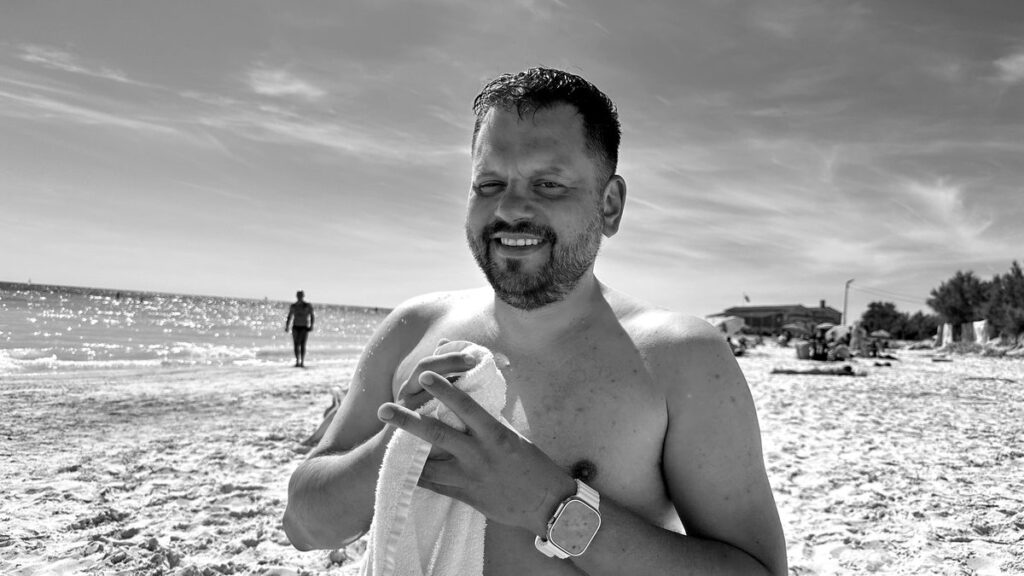
The Moment
The realization came from the vacation photos — I had simply gotten fat. We were on holiday in Italy, it was warm. I love the heat, the hotter the better. But somehow I already noticed that something had changed. I had trouble getting my shoes to close, and all my clothes fit — well, let’s say: tight.
In those photos I didn’t recognize myself. The picture I had of myself was a completely different one. Of course I look in the mirror, but in that moment I actually saw reality.
I like to eat, I like to cook, and always rich — pasta, cheese, butter, preferably in large amounts. Otherwise it doesn’t taste like anything, my grandmother always said.
But this time I had really gotten heavy. Gradually, not overnight — but that’s how it felt.
Looking Away
I’d struggled with my weight my whole life and tried everything that goes around — from keto to just eating less — but I never really engaged with what I ate, only ever tried to sand down the symptoms. That’s probably also why the weight crept up so quietly: people around you don’t notice when it’s slow, and you don’t see it yourself either, because you just buy bigger trousers and make your peace with it. Even as a kid I got completely frustrated shopping for trousers with my mother — either too tight or way too long — but back then, a week of eating less was enough to lose a couple of kilos and feel good again. That ping-pong game gets harder with age. Life changes, you move less, and at some point you’re stopping at every bakery on the way to an appointment because it’s become a groove. Thoughtless. No awareness of what I ate, no real awareness of my own body — maybe out of helplessness, not knowing how to change it, or fear of not having the discipline. Looking back, though, the discipline was never missing. The problem was: I didn’t know what to aim it at.
The Inheritance
I’d never owned a scale and always judged my weight by feel and by fit — a few times a year at the doctor’s, when I had myself checked out. Same after the Italy trip in 2024. Just under 95 kilos. I knew I was carrying a bit extra, but this was a new level, and this time it wasn’t just a number on a scale. Heart disease and diabetes run in my family, and my doctor made it clear that at my age, with that genetic load, I was at a point where it was really about my health — yes, maybe about more than that. It’s hard to describe how that moment feels. A bit like being shoved into cold water — a shock runs through your whole body and reality slaps you in the face, no velvet gloves, raw and pretty brutal. I’d never really managed to change it, but now I had to, and my doctor could only give me pointers. I had to face my diet head-on — including the wrong self-assessment I’d been carrying: I don’t actually eat that much. Which was only partly true — I mostly ate the wrong things.
The Trash Bag
I already knew before the doctor’s visit that I had to do something, and the plan was really just to eat a little less candy — though “a little” was relative in my case, because whether it was bars of chocolate, bags of licorice, or packs of wafer sticks: always by the full pack, tear it open, wipe it out. But I knew that wouldn’t be enough anymore, that it would just be a few kilos again, back after two weeks of restraint and a return to the old groove — probably with interest.
So the step had to be more drastic, and since I’d read here and there that a life entirely without industrial sugar is possible, in that moment of panic it was the only step available to me. The same day I came home from the doctor, I took a trash bag and threw out everything that contained industrial sugar — yes, really everything — and only then did I realize how much that was, because pretty much everything we had at home contained sugar. So there I was, with empty cupboards and the decision to give up something that’s in everything. Why, for god’s sake, is there sugar in everything?
So I started digging deeper into this decision, and looking back, I think that was the real turning point — because the weeks that followed weren’t easy.
The First Week, and What Came After
Research, learning everything I could, became my main occupation in that phase, and without realizing it, I outsmarted myself pretty well — because at some point, abstaining was just the logical consequence, not a fight anymore. The first two weeks were still genuinely hard — cravings and the urge for something sweet were agonizing on some days, I felt almost sick, with headaches and sweats. But the stretch where that was true — and that BUT is doing real work — was very short. Toward the end of the second week, changes started that made me sit up: I slept better, the energy slump that reliably hit me every day at eleven in the morning suddenly stopped showing up, and I was steadily awake and sharp all day in a way I didn’t know. I bought a scale and started weighing myself daily — not out of fear, but curiosity. The first kilos went fast, then steadily. That was the start of the journey I’ve been on ever since, and now, two years later, I’m at 73 kilos. Those two years were absolutely no ordeal, no odyssey of deprivation.
Today
These days I don’t think much about my weight, honestly about as little as before — I still weigh myself every morning, it’s part of the routine, but there’s no more fear of the number, no more negotiating with the mirror. What really changed isn’t the number, it’s my taste: things I used to love now taste too sweet, too empty, too loud, and I still eat richly, gladly — I’m still someone who enjoys food. That I’ve lost weight and it’s settled into a normal range is only the side effect — that was never the plan. Today I follow my taste. Not a craving anymore.