inner arts
I Ate a Lie for Decades — Slice by Slice
The Vow
New Year’s Eve, I’m eighteen, somewhere between too much alcohol and the Backstreet Boys and a resolution that felt bigger than it was. I decide to go vegetarian. No triggering incident before it, no image that shook me — just the feeling that I wanted to be against something, and meat was the obvious target. For a year I eat vegetarian, to my family’s great bewilderment and, I’m sure, plenty of incomprehension. It came on fast and it was gone just as fast. Barbecues were the rule in our house, not the exception, and in an environment that never engaged with the question, a conviction with no foundation eventually just fizzles out. I don’t say this as an accusation. None of us had the knowledge it would have taken to make it more than a spite reaction.
The Lie on the Label
What I lacked back then wasn’t willpower. It was the disconnect we were taught before we could even ask questions. A price tag reveals nothing about the factory behind it. The slice of ham on the bread reveals just as little about the animal. We learned to see meat as a product, as merchandise in the fridge aisle, not as what’s left when a sentient being is slaughtered. The packaging does its part: happy cows on green pastures, a seal with a little heart on it, the word “animal welfare” in a typeface that looks trustworthy. I actually looked into this. A pig on the better “barn+space” welfare tier gets a mere 0.94 square meters instead of 0.75 — that’s the difference the better seal is stuck on for. In 2024, eight out of ten packages sold still came from the two worst forms of husbandry; organic, the only label that genuinely means more, sat at just over six percent. The mandatory government label meant to finally make this honest won’t arrive before January 2027 at the earliest, and even then only for fresh pork from German farms — a deadline that’s already been pushed back more than once. Until then, you’re buying a good feeling, not a better life for the animal. And what good is a better life anyway, if it’s only meant to be ended, cruelly, as quickly as possible?
Falling Back
I didn’t fall back because some argument convinced me. I fell back because I like eating well, and because familiar food is easier than new food. Then there’s something bigger I only understand in hindsight: I was born in the late seventies, right in the middle of a generation that never learned to question meat, because our parents still remembered scarcity. After the war, pork consumption in Germany rose from nineteen to almost thirty kilos per capita within ten years — a genuine feeding frenzy after years of too little. What was still a deliberate signal of prosperity for our parents was, for us, simply everyday life — never questioned, never decided. On top of that: no internet, no way to set anything against what was printed on the package except your own gut feeling. We grew up with more freedom than the generations after us, and with less oversight — and that same carelessness carried straight over into how we ate. Afterward I lived for decades without giving my diet a single serious thought. Not a slow slide back — a complete return, and then simply: thoughtless.
The Real Trigger
What pulled me out of it is written down elsewhere already — the day my partner and I took a trash bag and threw everything containing industrial sugar out of the kitchen. What I want to add here is more honest than I’d like: cutting back on meat was, at first, a byproduct of that, not the goal. Sausage almost always contains sugar, and so do most processed foods — in that big clear-out, both left the cupboard together, without me ever making a decision against meat. The actual trigger was something else: learning what food actually does to my body. And that, I’ll admit, came from a fairly selfish place. Only once I understood what was bad for me did I start thinking about the animals that die for it. I don’t want to dress this up. It’s also the result of the same societal blinders I described above — someone who’s only ever learned to see meat as merchandise thinks of themselves first at the checkout, not the animal. It wasn’t just my own research that helped, either: social media has shown, over the last few years, what actually happens behind the scenes of animal farming — real footage instead of the cow from the packaging. That stayed with me, even though the first push came from somewhere else. In the end it was like with the weight: the change didn’t come because I set out to make it, it came because I started actually looking.
The Kitchen Now
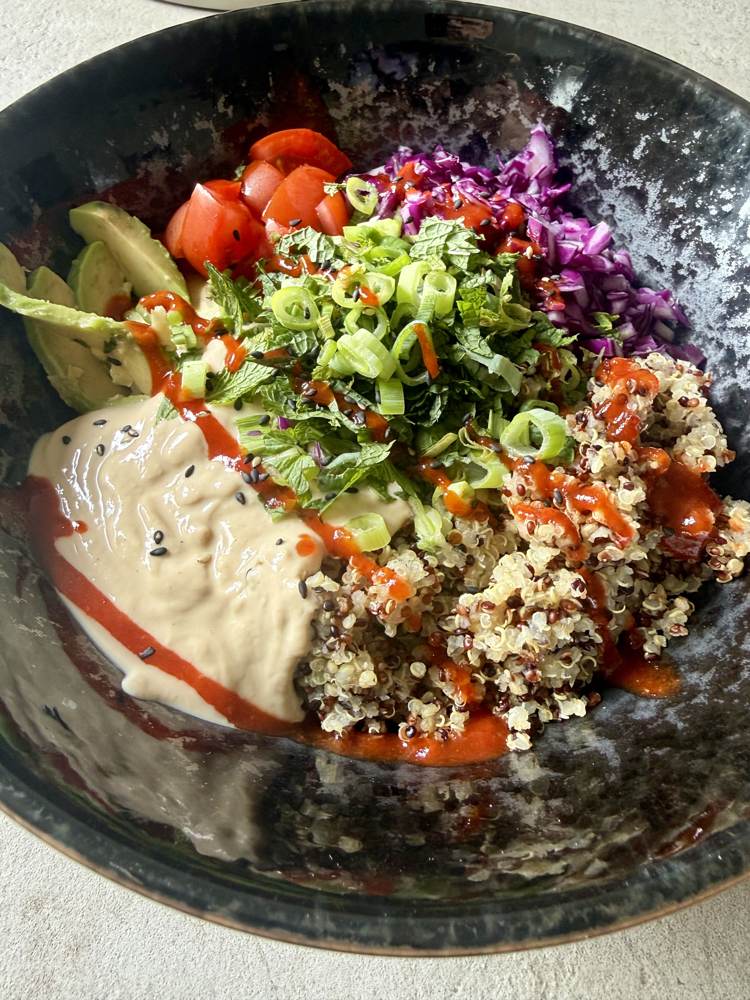
My kitchen looks different today, and not because I’m denying myself anything. I try things out, purely out of curiosity: a creamy sauce made with silken tofu instead of cream, liverwurst made from smoked tofu and kidney beans that’s barely distinguishable from the original by taste. A tomato sauce with tofu, nori, and capers comes eerily close to a tuna sugo. Breakfast is often a burrito with beans or hummus and quinoa, or oatmeal; banana bread with soy yogurt instead of butter as a snack. Tofu is as much a given in my kitchen now as cream used to be. I’m not primarily replacing anything — I’m experimenting. If it tastes good, great. If it doesn’t, then it doesn’t.
I don’t have relapses, because the word itself sounds like coercion to me, and I don’t force anything on myself. But when I walk past the meat counter at the supermarket these days, the sight nearly disgusts me. I no longer just see slices of ham. I see the dismembered bodies of animals, cut into bite-sized pieces for someone who was never supposed to see any of this in the first place.